
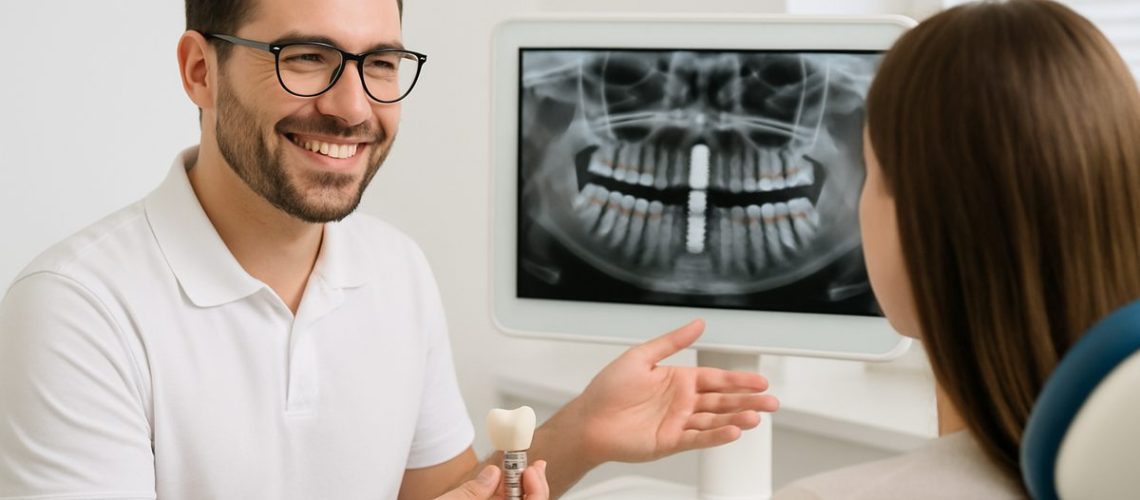
A dental implant service helps replace missing teeth with surgically placed implants and long-lasting prosthetic teeth. This brief guide explains what a dental implant service entails, who benefits, the primary types of treatments, what to expect during the process, recovery and risks, cost basics, and key questions to ask before choosing care. Read on to learn how a dental implant service can restore function, appearance, and oral health.
What is a dental implant service?
A dental implant service places small posts (usually titanium or zirconia) into the jawbone to act as artificial tooth roots. After surgical placement, a crown, bridge, or full-arch prosthesis is attached to restore chewing and appearance. Implants differ from dentures and traditional bridges because they fuse to the bone (osseointegration), thereby preserving the jawbone and offering more stable function and a natural appearance.
Who is a good candidate for a dental implant service?
Good candidates have healthy gums, sufficient jawbone (or a willingness to undergo grafting), and realistic expectations. Non-smokers do better, but smokers who quit can still qualify. Patients with controlled medical conditions (like diabetes) may be eligible after medical clearance. Children and people with severe, uncontrolled illnesses may need alternatives. A provider will evaluate the health of the bone and gums, as well as the overall medical history, before recommending a plan.
Types of dental implant service options
Single-tooth implant
One implant supports a single crown to replace a missing tooth. This preserves adjacent teeth and feels like a natural tooth.
Implant-supported bridges & multiple implants
Several missing teeth can be replaced with fewer implants supporting a bridge. This option is more stable than removable partials and distributes bite forces evenly.
Full-arch restorations (All-on-4, zygomatic implants)
Full-arch solutions can restore an entire upper or lower jaw, sometimes in a single day. For severe bone loss, zygomatic implants anchor into the cheekbone, thereby avoiding extensive grafting.
What to expect during a dental implant service: step-by-step
Consultation and digital planning
Expect 3D imaging (CBCT), intraoral scans, and a discussion of options. Digital planning helps map implant positions and predict outcomes for a dental implant service in the Dallas–Fort Worth Metroplex.
Surgery and implant placement
Surgery may use local anesthesia, sedation, or IV anesthesia. Guided placement tools improve accuracy. Most procedures are outpatient and take one to a few hours, depending on complexity.
Healing, grafting, and restoration
If bone grafts or PRF are required, the healing time may be extended. Osseointegration usually takes several months before final crowns or bridges are attached. Some practices offer same-day provisional teeth for esthetics and function.
Recovery, risks, and how to care for implants
Recovery includes swelling and mild pain for a few days, a soft diet, and follow-up visits. Good oral hygiene and regular dental cleanings reduce the risk of infection. Complications can include infection, nerve injury, or implant failure; however, experienced surgeons and careful planning can help mitigate these risks.
Cost, financing, and insurance for a dental implant service
The cost varies depending on the number of implants, grafting, materials, and lab work. Dental insurance may cover parts of the treatment, but rarely the whole cost. Many offices offer payment plans, third-party medical financing, or in-house options to make a dental implant service in the Dallas–Fort Worth Metroplex more affordable.
Questions to ask before choosing a dental implant service
Ask about the surgeon’s credentials, years of experience, success rates, full-arch experience, digital workflow (CBCT, guided surgery), sedation options, warranties, and before-and-after photos.
About the Texas Center for Oral Surgery & Dental Implants and why patients choose them
The Texas Center offers board-certified oral and maxillofacial surgeons with over 50 years of combined experience. They offer on-site IV sedation, an in-house digital lab, and advanced technology, including X-Nav, CBCT, PRF, and zirconia milling. Their focus is on predictable outcomes, minimally invasive techniques, and concierge support for patients and referring dentists.
How to get started with a dental implant service
Book a consultation and bring any dental records or recent X-rays. The first visit includes evaluation, imaging, and a clear treatment plan. If you’re looking for a dental implant service in the Dallas–Fort Worth Metroplex, schedule a consultation to discuss options, costs, and next steps.